
Baghaei: Iran demanded its legitimate rights in response to U.S. proposal
The spokesperson for the Iranian Foreign Ministry emphasized that Tehran’s response to the U.S.-proposed plan was centered on demanding the nation's legitimate rights rather than seeking concessions.
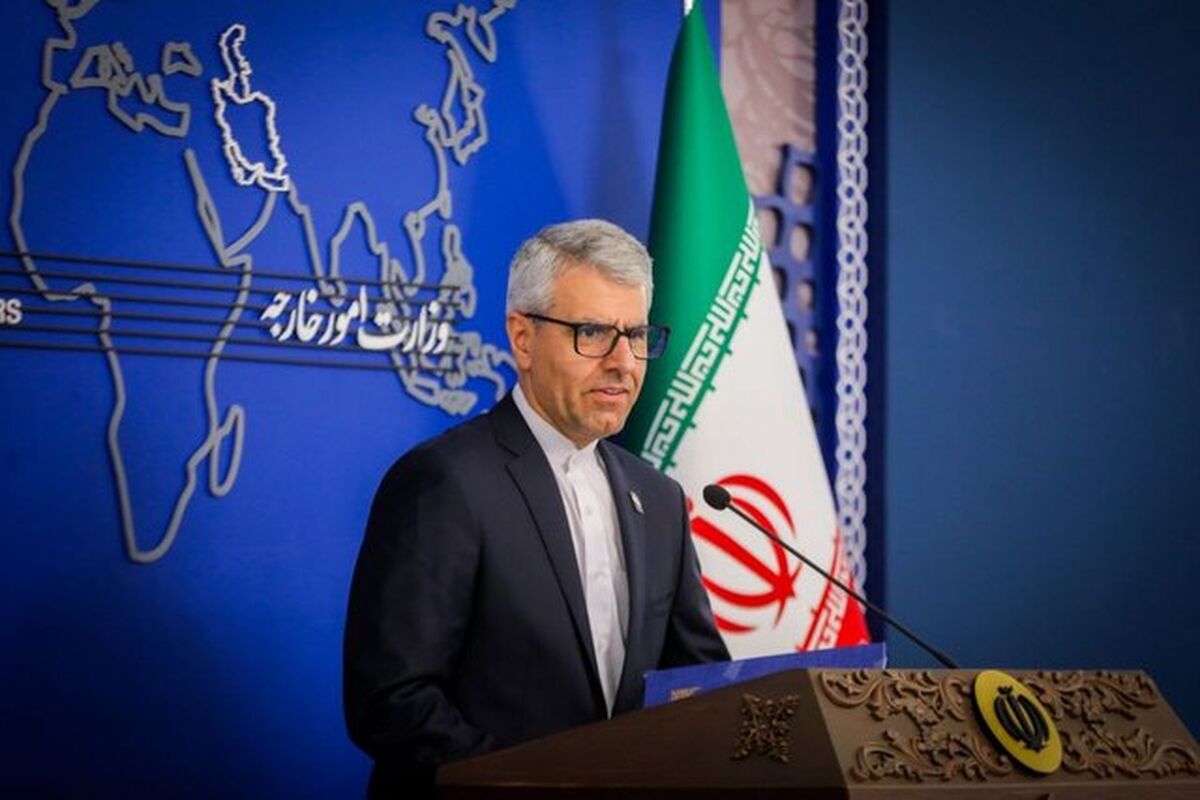
Esmaeil Baghaei addressed reporters during his weekly press conference regarding the U.S. President's recent remarks. Following a telephone conversation with the Prime Minister of the Zionist regime, the U.S. President had characterized Iran's response as "insufficient and unacceptable."
When asked what specific concessions Iran had demanded in its response that led to the American opposition, Baghaei clarified: "We did not demand any concessions; the only thing we demanded was the legitimate rights of Iran."
Continuing his remarks, the Foreign Ministry spokesperson raised the question of whether Iran’s demands—ending the war, stopping the maritime blockade (which is a form of piracy), and releasing assets belonging to the Iranian people that have been unjustly frozen in foreign banks for years—could be considered "excessive demands."
"Our proposal was based on ensuring safe passage in the Strait of Hormuz; is this an excessive demand?" Baghaei emphasized. "Is an important issue such as establishing peace and security in the entire region an irresponsible demand?"
The Foreign Ministry spokesperson stressed: "What we raised in our proposed text were reasonable and responsible demands, as well as generous proposals; a matter intended for the good, stability, and security of the region."
U.S. persists in unilateralism and unreasonable demands
Baghaei added: "Of course, we regret that the American side, still based on mindsets crafted and fabricated by the Zionist regime, persists in its unilateral views and unreasonable demands."
In response to a question regarding U.S. officials describing Iran as a "regional bully" and a factor of insecurity, the spokesperson for the diplomatic apparatus said: "Iran is a responsible actor in the region; we are not bullies, but rather anti-bullying."
Pointing to some of the crimes and actions of the U.S. and Israel in West Asia in recent years, he asked: "Was it us who committed aggression and crimes twice during a diplomatic process? The very presence of the U.S. in the region is an example of creating a cycle of violence and bullying, and it is clear to everyone that such rhetoric from U.S. officials cannot change the reality."
Security must be provided by regional countries
Regarding the deployment of Egyptian fighters in the UAE and the possibility of participating in operations to intercept Iranian drones, the spokesperson said: "Our relations with Egypt are based on mutual respect. There are continuous contacts between the foreign ministers of the two countries regarding bilateral and regional relations. What pertains to the security and stability of the region relates exclusively to the regional countries. It is our principled position that any intervention that harms regional security and undermines regional trust is rejected."
He emphasized: "Regional security must be provided by regional countries through the strengthening of collective trust. One must rely on such security. Recent events showed that security reliant on the presence of foreign forces only intensifies insecurity and is not stability-bringing for our region."
China is aware of Iran's position toward the U.S.
Regarding Trump’s visit to China and the possibility of Beijing mediating between Iran and the U.S., Baghaei said: "The visit to China is a bilateral visit that concerns themselves."
He added: "We are in continuous contact with China as one of our strategic partners and an influential country in the UN Security Council. The Foreign Minister recently visited China, and we reflected Iran's viewpoints. The Chinese are well aware of our positions. China correctly understands that the imposed war against Iran is not a passing incident but part of a global trend to intensify unilateralism by the U.S., which has damaged international norms."
The spokesperson emphasized that security in the region is very important for China, adding: "Our Chinese friends know well how to use these opportunities to warn against America's bullying actions in undermining international security."
Iran warns Europe against intervention in the Strait of Hormuz
Regarding the dispatch of French and British warships to the region, the Foreign Ministry official stated: "We very explicitly conveyed to European countries not to let the temptations of the U.S. and the Zionist regime in regional issues cause them to be inadvertently drawn into a crisis that will yield no benefit for them."
He added: "I think there is an awareness among many European countries that this has been an illegal, aggressive, and immoral war against Iran, and they did not allow U.S. pressures to make them—at least publicly—part of this illegal action that disrupts international peace and security. Therefore, any intervention in matters related to the Strait of Hormuz and West Asia will only complicate the situation."
Baghaei said: "Any country that believes in responsible behavior toward international peace and security, its citizens, and their economic welfare, must direct its pressures toward the parties that disrupted safe maritime passage from the beginning. The problem is the aggressive action of the U.S. and the Zionist regime; otherwise, the Strait of Hormuz was open before February 28 (Esfand 9)."
Pakistan remains the mediator between Iran and the U.S.
In response to ISNA’s question about Sunday’s conversation between the foreign ministers of Iran and Qatar, as well as the Qatari Foreign Minister's visit to the U.S. a few days ago, he said: "Many countries contact us. At the same time, regional countries have real concerns regarding the escalation of tensions, and we are grateful to the parties and countries that use all their good offices with goodwill to convince the opposing parties to de-escalate and create stability."
Baghaei emphasized: "The mediating party for the negotiations remains Pakistan, and Islamabad continues its activity as the official mediator. Other countries, including Qatar, are also in contact with both sides and have ideas and opinions which they raise whenever they deem necessary."
Countering third-party interference in negotiations
In response to a question regarding media reports on the UAE's actions and pressures against Pakistan to disrupt the negotiation process—including the deportation of Pakistani citizens—the Iranian Foreign Ministry spokesperson stated: "Pakistan will certainly carry out its work professionally. No mediator allows its professional actions to be influenced by third-party actors. These actions taken by the UAE against citizens of other countries who legally resided in that country are contrary to the law and inconsistent with human rights principles. The actions taken by the UAE against Iranian citizens are also certainly against human rights standards, and we consider ourselves duty-bound to support our nationals."
Pursuing the rights of our citizens in the UAE
Baghaei said: "Our consulate in Dubai has been mandated to continuously follow up on this issue; in Tehran, we are also pursuing the rights of our citizens in the UAE and will certainly not refrain from any action to protect the rights of our citizens."
Regarding U.S. pressure on the new Iraqi government, he emphasized that "all countries must respect the legal processes of every country regarding the election of their officials and their type of government," adding: "It is exclusively the right of the Iraqi people to decide about their government system and officials. Whatever decision they make will be respected by us."
The Iranian Foreign Ministry official continued: "American officials must answer how they allow themselves, contrary to all international principles, to so explicitly accuse the officials of other countries! This type of behavior has no basis, and surely Iraqi officials will react in any way they deem appropriate."
Bahrain government must respect its people
Regarding recent actions by the Bahraini government against its citizens, including Shia scholars, under the pretext of their support for Iran, he stated: "The actions Bahrain has taken over the past two months under the pretext of the Bahraini people's empathy with the Iranian people, or their mourning for the martyrdom of a Shia 'Marja', are gross violations of human rights. Furthermore, the revocation of citizenship from Bahraini citizens by that country's government is a medieval punishment that has been obsolete for years."
He emphasized: "In line with human dignity and the preservation of human rights principles, we explicitly declared our positions. The Bahraini government must respect its people, and certainly, wounding the feelings of the majority of Bahrain's people will not be in the interest of the stability and security of that country."
"Satisfaction of others is not important to us"
Regarding Trump's comment that he is not satisfied with Iran's response, Baghaei said: "We fight whenever necessary, and we use the weapon of diplomacy whenever we determine so to realize the interests of the Iranian nation. The satisfaction of others is not important to us."
This member of the negotiating team added: "The other side must prove itself and show its seriousness; so far, they have failed (refused/failed the exam). In every diplomatic process the U.S. has participated in over the past 20 years, it has constantly committed breaches of promise, including the withdrawal from the JCPOA in 2018 and, in the past year—worse than that—attacking the table of diplomacy and negotiation."
No one can remain indifferent toward crimes in Gaza, Lebanon, and Iran
Regarding the Taliban's position of "neutrality," he said: "In today's world, the duty is clear. Not only regional countries but the world is witnessing the fact that the war against Iran is an illegal war. This is confirmed by world public opinion. No country, party, or human being can remain indifferent toward the crimes ongoing in Gaza and Lebanon, and other crimes committed in recent years. This is both a moral and a legal obligation."
Priority: Focus on ending the war on all fronts
In response to a question about the content of Iran's proposal, Baghaei said: "We previously said that at this stage, our focus is on what has urgency, which is the termination of the war on all fronts, including Lebanon, ensuring the safety and security of navigation in the Persian Gulf and the Strait of Hormuz, and simultaneously stopping illegal actions and maritime piracy by the U.S. against commercial ships."
Zionist bases and the One-China Policy
Regarding reports of a Zionist military base in Iraq, he said: "We do not rule out any possibility regarding the malice of the Zionist regime. We will certainly raise this with the Iraqi parties."
On Taiwan, Baghaei stated: "Our position is very clear. UN General Assembly Resolution 2758 has clarified the matter regarding 'One China.' Any action contrary to it is rejected by us."
Regarding Putin's comments on U.S. leadership, he said: "The world should not be under the hegemony of a side that has no regard for recognized international norms and has threatened international peace and security."
Foreign Ministry is not a separate part of the sovereignty
Regarding claims that the Foreign Ministry opposes closing the Strait of Hormuz, he stated: "The Foreign Ministry is part of the Republic, and decisions made based on the system's hierarchy are completely obeyed (mutâ’) by the Foreign Ministry. A coastal country subjected to military aggression is permitted to take measures to prevent the misuse of the waterway. The Foreign Ministry is not a separate part of the country's decision-making system and sovereignty."
Response to Rafael Grossi
Regarding Grossi's comments that "war could not destroy Iran's nuclear program," Baghaei remarked: "Was it supposed to be destroyed through non-war means? These comments confirm our concern that the Director General has long distanced himself from his specialized and technical mission. These remarks do not help his 'personal ambitions'. The Agency should instead condemn the illegal actions of the U.S. and the Zionist regime."
"Pure lies" regarding the oil spill
Regarding Western media claims of an oil spill near Kharg Island, he said: "It is a pure lie (dorogh-e mahz). The news raised about the oil spill is fabricated."
Historical memory of U.S. behavior
In response to Trump's statement about "ransom," Baghaei said: "No U.S. administration has ever brought a smile to the faces of Iranians. The history of improper behavior dates back to the 1953 coup. The insults and terms they used regarding the Iranian civilization and nation will never be forgotten."
Venezuela's Uranium and the Minab School
Regarding the transfer of uranium from Venezuela to the U.S., he said: "We are not stingy (khasis nistim). We respect the decision of the Venezuelan government as a sovereign state."
Regarding the attack on the Minab school, Baghaei stated: "International conscience recognized that this was a calculated war crime. Regardless of how they try to 'whitewash' (sefid-shouyi) it, it became clear to the Iranian people what kind of 'aid' the U.S. provides."
"We have not yet settled accounts"
Regarding Netanyahu's comments, he said: "We have not yet settled accounts (tasviye hesab) with those who committed such crimes against the Iranian nation. If the opportunity is provided to our Armed Forces, it will be used in the best possible way."
Regarding the main points of disagreement, he added: "We are not talking about exchanging concessions. Freezing Iran's blocked money is not a 'concession'; it is a demand and a right. The termination of the 'maritime blockade' is the stopping of an illegal act, not a concession."
Addressing UK Accusations
Regarding the British Prime Minister's accusations, he said: "The UK cannot cover its failure to provide security for its citizens with cliché accusations. We should be proud that despite facing the crimes of a party that falsely calls itself the representative of Jews, not the slightest aggression has taken place against our Jewish compatriots or their synagogues." He concluded by asking if the UK PM condemned the Zionist attack on the synagogue in Tehran.