
A blood-sweating woman
Tehran (KNA) : Sweating blood from her face and the palms of her hands, a 21-year-old woman was admitted to an Italian hospital.
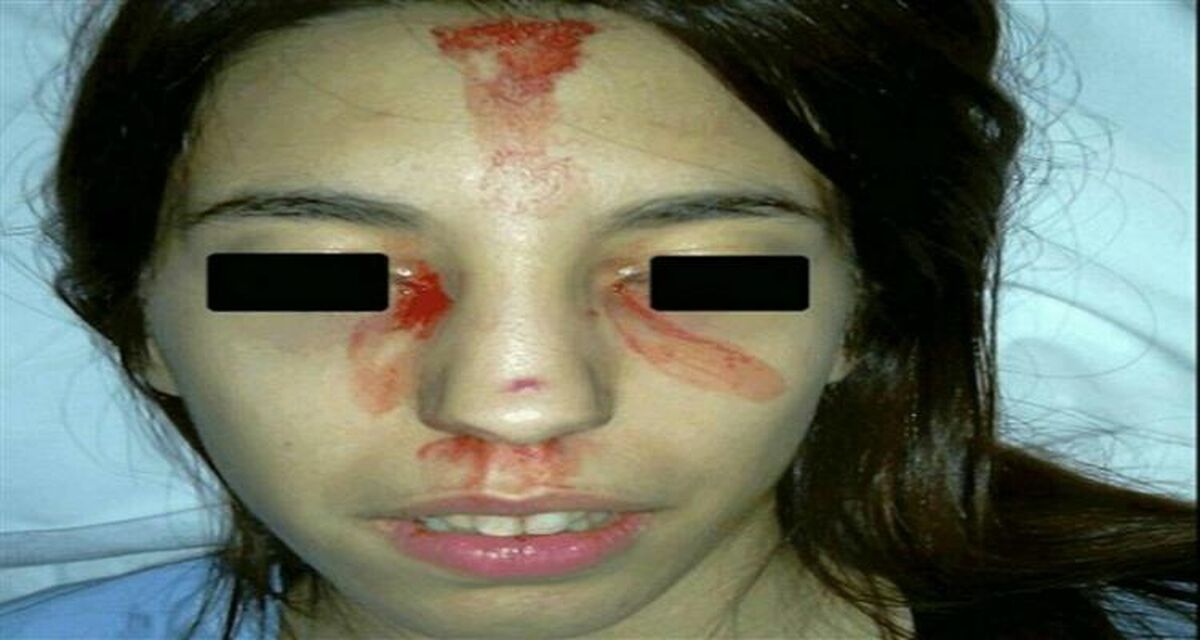
A 21-year-old woman was admitted to an Italian hospital while sweating blood from her face and the palms of her hands. Drs. Marzia Caproni and Roberto Maglie, both dermatologists at the University of Florence, reported the case Monday in the Canadian Medical Association Journal.
The patient, whose identity remains unknown as is customary in case studies, had no signs of scratches or wounds. Her spontaneous bleedings had no obvious trigger and each one lasted from one to five minutes and then ended.
Sometimes the bleeding occurred while the young woman was asleep, at other times, while she was exercising or physically active. The patient had endured the condition for three years.
Quite embarrassed by the oddness of her symptoms, the young woman had socially isolated herself and experienced symptoms of major depression, as well as panic disorder.
Analysis of her skin where the bleeding had occurred showed nothing abnormal. Tests of her blood revealed no coagulation issues or other problems.
Maglie did not respond to a request for comment. According to the journal, Maglie and Caproni diagnosed hematohidrosis, a rare disease known for spontaneous discharge of "blood sweat" through intact skin. The doctors first treated her depression and panic symptoms with an antidepressant, paroxetine, and an anti-anxiety medicine, clonazepam. Next, they prescribed propranolol, a beta blocker prescribed to patients with heart conditions, a drug which had been used in similar cases in the past. This treatment reduced her bleeding, did not end it though.
"I believe the case is real," said Dr. Jacalyn Duffin, a retired hematologist, and a medical historian and professor at Queen's University in Ontario, Canada.
Duffin traced the earliest mention of sweating blood back to Aristotle's writing in the third century B.C. In two instances, the Greek scientist and philosopher described sweat that either looked like, or really was, blood.
Reading about "lots of cases all around the world," Duffin said they shared surprising similarities in the way they happened and how they occurred. "The more research I did historically, the more I found out these people didn't know each other, ergo, they couldn't be inspired by each other," said Duffin. These individual cases, then, could not be attributed to copycat behavior.
In the accounts she read, the most common places for sweating blood were the forehead, scalp, face, eyes and ears. "Some of them have had it on their trunk, some on their limbs -- it appears it can be anywhere," said Duffin.
Pain or tingling foreran some instances of sweating blood, while several patients experienced headaches or hypertension. Sweating blood is not exclusive to females, but most patients were women.
"Although it's horrible to look at and horrible to suffer, it seems not to be associated with negative [health] outcomes," said Duffin, adding that none of the patients reported in modern times had died of it.
"It's terribly embarrassing and when nobody seems to know what causes it, it's very frightening to have it," said Duffin. "Doctors are perplexed and yet it's so obvious and scary looking."
"In all the cases that were published, the blood was tested and there was no coagulation problem -- including in the case today," said Duffin. "Because the first thing you think is, 'Oh, they're a bleeder, they have a bleeding disorder.' There was nothing wrong with their blood, so that implies there's something wrong with their skin."
There, also, the evidence was inconclusive. In some cases, blood appears in the sweat ducts, yet the ducts of other patients remain free of blood and Skin biopsies appear normal.
While theories abound, none have been proven, said Duffin.
"It could be that this phenomenon of having blood appear on your face could have multiple different causes," she said.
In some cases patients have experienced a horrible fright before the bleeding starts. "Suddenly your adrenaline goes up and if your adrenaline goes up, maybe it does something to the microvasculature -- your tiny capillaries -- in your skin that causes them to shrink or explode," suggested Duffin. This unproven scenario could be one reason of bleeding skin.
"Or perhaps it's an inherited fragility of the blood vessels in the skin," said Duffin. "Or maybe it's triggered by some chemical we don't know about."
"What we learned from the cases I reviewed in the literature, it can spontaneously remit -- in other words it can just vanish with no explanation," added Duffin. "It comes with no explanation and it goes with no explanation."
Lack of explanation leads others to turn to religion.
Source: CNN